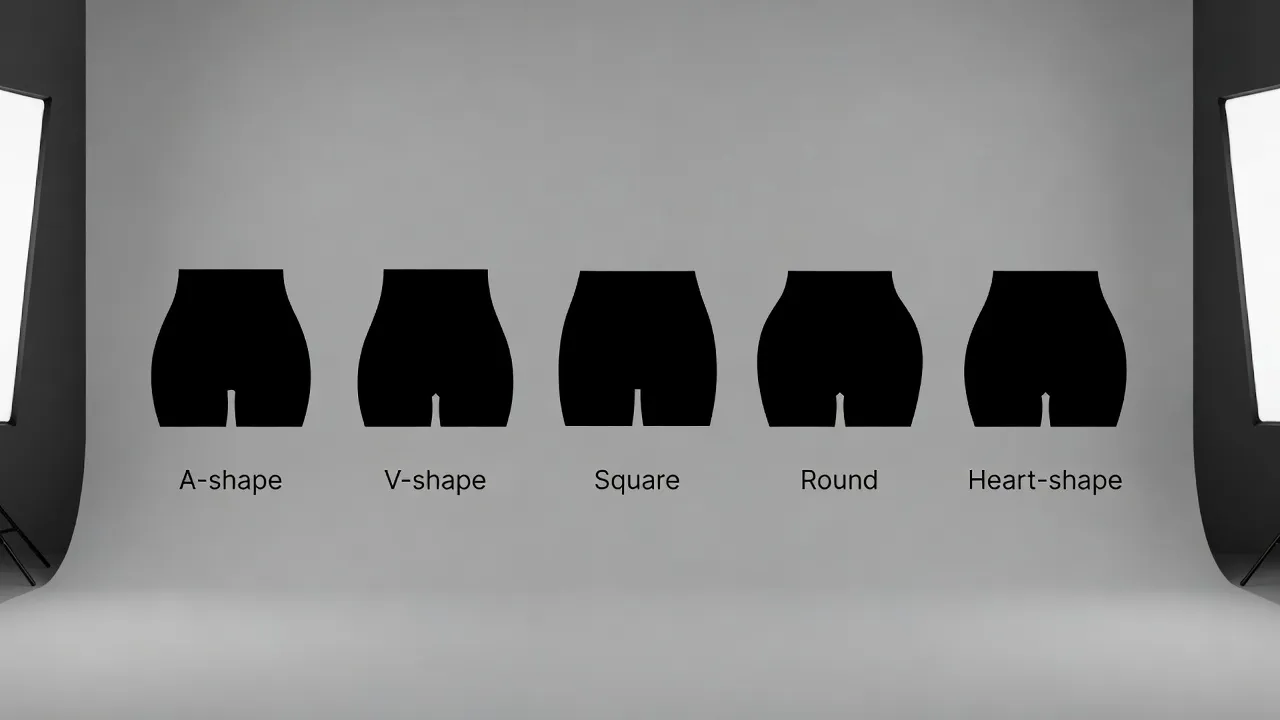
Human buttocks shapes are determined by bone structure, fat distribution, and muscle development, falling into five main categories: square (H-shape), round (O-shape), heart or inverted triangle (A-shape), V-shape, and shelf-shaped. Your pelvic width, hip dip depth, and how your body stores adipose tissue dictate your baseline glute silhouette long before you step foot in a gym.
While target exercises can build muscle volume, your underlying skeletal geometry sets hard limits on what changes are anatomically possible. Understanding your specific glute shape helps you set realistic fitness expectations, select targeted workouts, and preview visual transformations accurately.
What determines human glute shapes?
Glute shapes are primarily created by the relationship between the iliac crest (hip bones), the femur heads, gluteal muscle volume, and subcutaneous fat distribution.
Your genetic blueprint dictates where fat deposits land across your lower body, as well as the width of your pelvis. According to anatomical research published on Wikipedia's Gluteus Maximus entry, the gluteus maximus is the largest muscle in the human body, acting as the primary driver of upper buttock projection.
Three main physical components construct your unique glute profile:
- Skeletal structure: A wide pelvis creates a wider base, whereas high iliac crests often lead to a longer, flatter upper glute region.
- Fat distribution: Estrogen and testosterone influence whether adipose tissue accumulates along the upper hips, lower hips, or thighs.
- Muscular thickness: The combined mass of the gluteus maximus, gluteus medius, and gluteus minimus dictates overall fullness and firm projection.
Understanding this anatomical baseline prevents frustration when trying to alter your silhouette through workout routines alone.
What is a shelf-shaped buttocks shape?
A shelf-shaped buttocks shape features significant muscle or fat projection at the top of the gluteal crest, creating a visible horizontal ledge right below the lower back.
This shape occurs when there is dense muscle volume in the upper portion of the gluteus maximus and gluteus medius, paired with high fat storage around the upper hip area. It is frequently seen in powerlifters, athletes who prioritize heavy hip thrusts, or individuals with specific genetic fat storage patterns in the upper pelvis.
| Anatomical Region | Characteristic |
|---|---|
| Upper Glute Crest | Dense Volume |
| Horizontal Shelf | Forms at the upper glute crest |
| Lower Glute | Sits beneath the shelf |
Unlike flat or square profiles, the shelf shape drops steeply from the upper glute line toward the lower crease. Building a shelf shape naturally requires heavy resistance training targeting the upper glute fibers alongside a higher calorie intake to encourage soft tissue density.
What are V-shaped and A-shaped buttocks shapes?
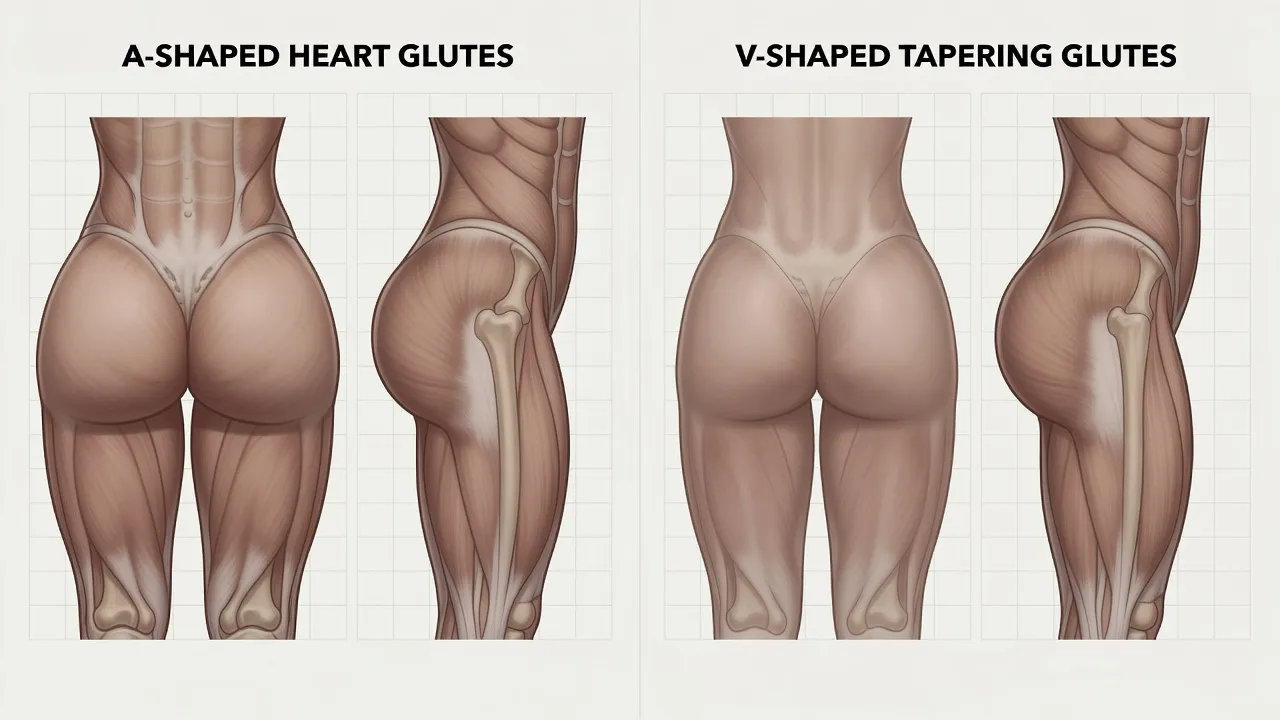
V-shaped buttocks taper inward toward the bottom crease, while A-shaped (heart-shaped) buttocks feature a narrow waist that widens across the lower hips and thighs.
The V-shaped profile is common among individuals with higher shoulder-to-hip ratios or lower estrogen levels. The angle between the pelvis and the hips slants inward, causing the upper glutes to hold more volume than the lower region. This shape frequently develops as body fat drops or as muscular density decreases with age.
In contrast, the A-shape (also referred to as the inverted heart shape) exhibits maximum fullness below the waistline. The lower gluteus maximus and outer hips store most of the mass, tapering into narrower upper hips. According to clinical studies on body fat distribution hosted by the National Institutes of Health, gynoid fat patterning naturally directs subcutaneous fat to the lower pelvis and upper thighs, making the A-shape very common in women prior to menopause.
The 5 main glute shape types explained
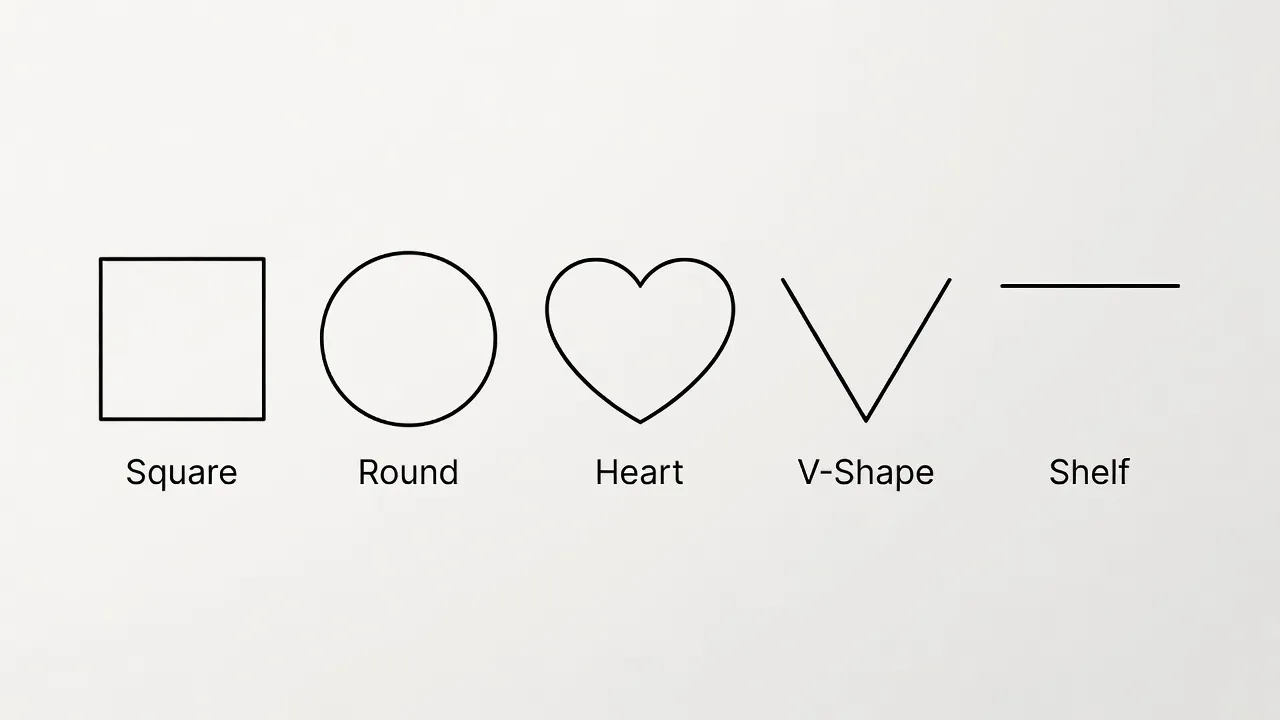
The five standard glute shapes are Square (H-Shape), Round (O-Shape), Heart (A-Shape), Inverted (V-Shape), and Shelf-Shape.
Every human body fits into one of these baseline structural classes, though body composition changes can alter how pronounced the shape appears.
| Shape Type | Visual Description |
|---|---|
| Square / H | Rectangular form with vertical sides and horizontal top and bottom |
| Round / O | Curved sides meeting at a rounded bottom |
| Heart / A | Wider at top with curved sides tapering to a point at bottom |
| Inverted / V | Wider at top with angled sides converging to a point at bottom |
| Shelf / Top-Heavy | Top projection wider than the body below |
1. Square (H-Shape)
- Visual marker: The line from your ilium (hip bone) to your outer thigh runs straight down parallel to the spine.
- Anatomy: High, prominent hip bones with minimal curve at the waist or upper hips.
- Training focus: Target the gluteus medius and upper gluteal fibers to add volume to the side hip region.
2. Round (O-Shape)
- Visual marker: Even fat and muscle distribution from top to bottom, creating a smooth spherical contour.
- Anatomy: Curved pelvic structure paired with uniform fat distribution across the gluteal stack.
- Training focus: Maintain overall gluteus maximus volume with balanced compound movements like deep squats and lunges.
3. Heart or Inverted Heart (A-Shape)
- Visual marker: Small waist transitioning into broad fullness across the lower buttocks and upper hamstrings.
- Anatomy: Wider pelvis base with significant fat storage in the lower gluteal region and outer thighs.
- Training focus: Heavy deadlifts and Romanian deadlifts to strengthen the lower glute-hamstring tie-in.
4. V-Shape (Inverted Triangle)
- Visual marker: Broad upper hips that narrow sharply toward the bottom of the buttock fold.
- Anatomy: Broad shoulders or wide upper waist with low fat volume in the lower glute region.
- Training focus: Hypertrophy work targeting the lower gluteus maximus, such as step-ups and seated hip-abduction movements.
5. Shelf Shape
- Visual marker: Pronounced horizontal projection at the top crest of the glute, tapering downward.
- Anatomy: Strong upper gluteus medius muscle development combined with upper-pelvic fat deposits.
- Training focus: Upper glute isolation exercises like cable kickbacks paired with controlled hyper-extensions.
How do men's body shape types differ from women's glute shapes?
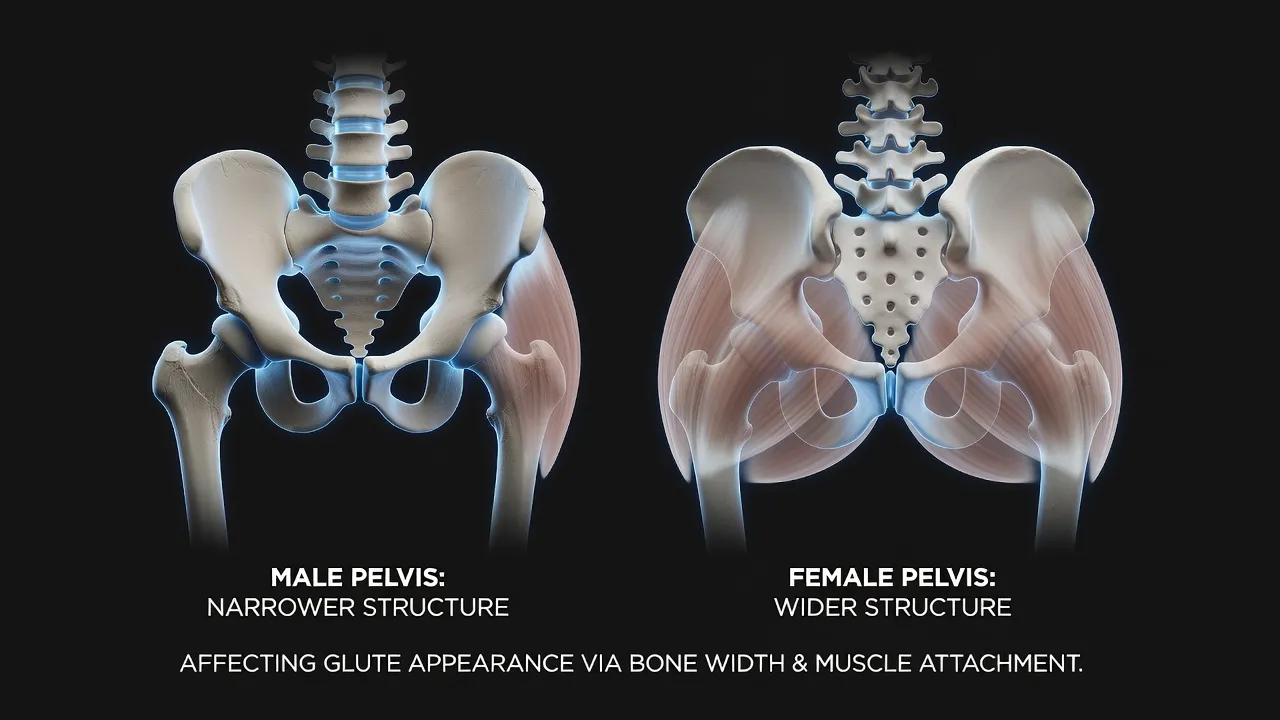
Men’s body shape types typically feature narrower pelvic angles and less subcutaneous fat storage around the hips, resulting in a square or V-shaped glute contour.
The male pelvic anatomy is structurally narrower and taller than the female pelvis. This skeletal difference means men naturally lack the wider hip crest that creates A-shape or round glute contours. Testosterone drives visceral fat storage around the abdomen rather than subcutaneous fat around the hips and thighs.
For male body shape descriptions, glute appearance relies almost entirely on skeletal muscle volume rather than fat distribution. Men aiming to round out a square glute shape must build the gluteus medius through heavy lifting, as body fat will rarely deposit in the side hip area naturally.
How to visualize glute progress on your photos before training
Visualizing potential body changes on your own photos helps you set realistic fitness goals before committing to months of training.
Building muscle or losing fat takes months of continuous effort. Many people set unrealistic expectations because they do not understand how their native bone structure will look with extra glute volume. Previewing structural adjustments digitally allows you to see how your specific body shape class responds to added muscle or reduced hip fat.
If you want to edit your photos to test out realistic goal shapes or simply enhance photos for social media, manual editing tools like Photoshop Liquify can be difficult to use and often warp the background lines behind you.
| METHOD | BACKGROUND PROOF? | EDITING SPEED | TARGET ACCURACY |
|---|---|---|---|
| Photoshop Liquify | Manual masking req. | 15-30 minutes | High manual control |
| BodyBlend App | 100% Automatic | 1-Tap AI Process | High preset control |
| Manual Mobile Apps | High warp risk | 5-10 minutes | Moderate |
Using a specialized tool like the BodyBlend AI body editor makes this process effortless. Unlike old-school liquify tools that distort door frames and walls, BodyBlend uses machine learning to reshape specific body parts while keeping your face, skin tone, clothing textures, and background completely untouched.
As of October 2026, BodyBlend on the App Store offers 17 preset body shapes and 11 targeted body part edits. You can upload a photo, apply a subtle curvier glute edit, and instantly compare the before and after to set a concrete target for your gym routine. If you need gym inspiration to stay consistent with your routine, checking out motivation quotes for gym can keep your mindset sharp.
Technical comparison: Glute shapes and modification limits
Skeletal limits dictate that you cannot convert a true V-shape into a pure round shape solely through exercise if your pelvic bone width is narrow.
The table below breaks down each glute shape type, its skeletal traits, realistic modification options, and how digital visualization tools handle each frame.
| Glute Shape Type | Bone Structure Traits | Primary Muscle Target | Realistic Natural Outcome | Digital Preview Preset |
|---|---|---|---|---|
| Square (H-Shape) | High iliac crests, straight pelvic line | Gluteus Medius & Minimus | Fills outer hip dips, widens upper hips | Curvy / Fit preset |
| BodyBlend App | Compatible with all bone frames | Automated AI layer mapping | Instant photo visualization without background warp | 17 Presets + 11 Body Edits |
| Round (O-Shape) | Medium-wide curved pelvis | Gluteus Maximus (All heads) | Increases projection and firmness | Hourglass / Fit preset |
| Heart (A-Shape) | Wide pelvic base, lower hip flare | Gluteus Maximus lower fibers | Tightens lower crease, accentuates waist | Curvy / Hourglass preset |
| V-Shape | Narrow hips, broad waist / shoulders | Upper Gluteus Maximus & Medius | Lifts upper glute line, fills top dips | Muscular / Fit preset |
| Shelf Shape | High pelvic crest, tight upper insertion | Lower Gluteus & Hamstrings | Balances bottom volume to match top | Curvy / Ripped preset |
Workout strategy for your specific glute shape
Targeting specific glute heads allows you to adjust your silhouette within the limits of your skeletal frame.
While you cannot change bone placement, hypertrophy in targeted zones changes how soft tissue lays over the pelvis. Exercise guidance from ACE Fitness highlights that isolated hip abduction directly activates the gluteus medius to widen upper hip contours.
| Muscle | Target |
|---|---|
| Gluteus Medius | Upper / Outer Fullness (Fixes Square/V) |
| Gluteus Maximus | Rear Projection (Builds Round/Shelf) |
| Gluteus Minimus | Deep Structural Stability & Side Lift |
- For Square shapes: Focus on side-lying hip abductions, cable hip abductions, and banded monster walks to widen the upper gluteus medius.
- For V-shapes: Prioritize heavy hip thrusts, barbell glute bridges, and Romanian deadlifts to build density in the lower gluteus maximus.
- For A-shapes: Incorporate high-rep kettlebell swings and bodyweight lunges to tighten the hamstring-glute tie-in without over-bulking lower thighs.
- For Round shapes: Stick to heavy compound movements like barbell squats, leg presses, and Bulgarian split squats to maintain symmetrical mass.
- For Shelf shapes: Add lower glute exercises such as deep sumo squats and reverse lunges to balance out the top-heavy distribution.
Frequently Asked Questions
Can you change your glute shape naturally with exercise?
Yes, you can alter the muscular volume and fat ratio over your bones, but you cannot change your underlying pelvic skeletal frame. Building muscle fills out areas like hip dips or flat upper glutes, transforming a square shape into a rounder profile over time.
Why do hip dips make glutes look square?
Hip dips are high, natural gaps between your ilium bone and the head of your femur. When your skeleton has this high gap, subcutaneous fat drops above and below the indentation, creating an H-shaped or square silhouette.
Which glute shape is the most common?
The square (H-shape) and heart (A-shape) are the most common glute profiles in adults. Estrogen levels encourage fat storage in the lower hips to form A-shapes, while straight pelvic structures lead to H-shapes.
What is the difference between a shelf butt and a heart butt?
A shelf butt features maximum muscle and fat mass at the very top crest of the buttocks, creating a horizontal ledge. A heart (A-shape) butt places maximum volume at the bottom of the buttocks near the upper thighs, tapering inward toward the waist.
Why does a V-shaped glute develop with age?
As estrogen levels decrease during aging, subcutaneous fat shifts from the lower hips to the abdominal area. This loss of lower glute fat causes the bottom of the buttocks to taper inward, turning round or heart shapes into V-shapes.
How can I see how I would look with a different glute shape?
You can preview glute changes on your photos using the BodyBlend app. By uploading your photo and selecting presets like Curvy or Fit, you can instantly see realistic target shapes on your actual frame without background distortion.