
A toned body describes a physique with visible muscle definition and low enough body fat levels to reveal underlying muscle structure. Achieving this look requires body recomposition, which means building lean muscle tissue while losing body fat. Contrary to older fitness myths, getting firm muscle tone does not come from light weights and high reps, but rather from progressive resistance training combined with target protein intake and calorie management.
Fitness science has discarded outdated concepts like spot reduction and ultra-high repetition workouts. As of October 2026, exercise physiologists emphasize that building muscle density through structured strength training is the only way to shape the human frame. Whether your goal is to set a baseline before starting a workout program or to preview physique milestones for social media photos, understanding the science behind muscle definition saves months of wasted effort.
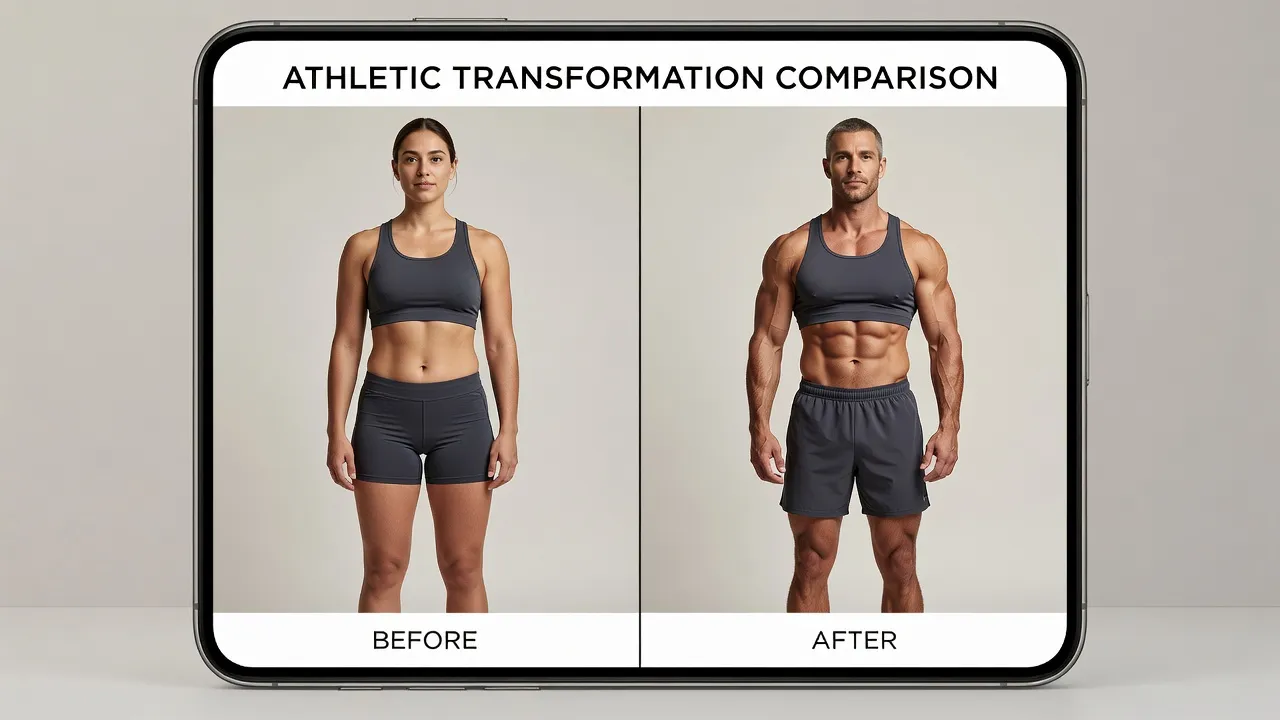
When starting a physical transformation, seeing what your frame looks like with higher muscle mass helps maintain focus. Instead of struggling with manual Photoshop brushes that warp surrounding objects, digital progress tracking has evolved. Tools like the BodyBlend app let you preview 17 preset body shapes (such as Fit, Muscular, or Ripped) directly on your photos, automatically preserving your skin tone, clothes, and background without distorting straight lines.
What is the definition of 'toning' versus 'body recomposition'?
The term 'toning' is an informal cosmetic description, whereas 'body recomposition' is the physiological process of building muscle while shedding body fat.
Muscle tissue itself cannot actually become "toned" or "soft" in a physiological sense; it can only grow larger (hypertrophy) or shrink smaller (atrophy). What people call a "toned appearance" is simply the visual result of having sufficiently developed muscle mass underneath a thin layer of subcutaneous fat. If body fat is high, well-developed muscles remain hidden. Conversely, if body fat is low but muscle mass is minimal, the body appears lean rather than sculpted.
Body recomposition addresses both variables at the same time. While traditional bodybuilding divided training into distinct "bulking" (gaining mass and fat) and "cutting" (losing fat and muscle) phases, recomposition focuses on optimizing daily protein intake and resistance training to shift your body composition ratio. This distinction is vital because chasing "muscle tone" without challenging your muscles with heavy loads fails to produce the structural density needed to change your silhouette.
What do ACSM guidelines recommend for resistance training to tone the body?
The American College of Sports Medicine (ACSM) recommends training each major muscle group 2 to 3 days per week using 8 to 12 repetitions per set for overall muscle tone and strength.
To produce structural muscle adaptation, guidelines published by the American College of Sports Medicine outline clear resistance standards. Novice to intermediate individuals should aim for multi-joint compound movements—such as squats, deadlifts, chest presses, and rows—to maximize muscular recruitment across multiple joints.
- Frequency: 2 to 3 days per week per muscle group, allowing at least 48 hours of recovery between sessions targeting the same muscle.
- Intensity: 60% to 70% of your 1-repetition maximum (1RM) for beginners; 70% to 85% of 1RM for intermediate lifters.
- Volume: 2 to 4 sets per exercise, targeting 8 to 12 repetitions per set for hypertrophy and mechanical tension.
- Exercise Choice: 8 to 10 exercises covering major muscle groups (chest, back, shoulders, arms, quadriceps, hamstrings, glutes, and core).
Older workouts pushed the belief that lifting 2-pound dumbbells for 30 repetitions would "lengthen" muscles without adding bulk. Modern biomechanics proves that muscle insertion points are genetically fixed; you cannot lengthen a muscle. You must apply mechanical tension using adequate weight to stimulate muscle protein synthesis.
How much protein per kg bodyweight is recommended for muscle hypertrophy?
Sports nutrition research recommends consuming between 1.6 and 2.2 grams of protein per kilogram of bodyweight daily to maximize muscle hypertrophy.
Protein provides the essential amino acids required to repair damaged muscle fibers following resistance workouts. An official position stand by the International Society of Sports Nutrition confirms that an intake of 1.6 to 2.2 g/kg/day (approximately 0.73 to 1.0 grams per pound) is optimal for physically active individuals seeking to build or preserve lean mass during body recomposition.
Daily Protein Target = Body Weight (in kg) × 1.6 to 2.2 grams
For a person weighing 70 kg (154 lbs), this translates to a daily target of 112 to 154 grams of protein.
| Body Weight (lbs / kg) | Maintenance Baseline (0.8 g/kg) | Recomposition Target (1.6 g/kg) | High-Def / Deficit Target (2.2 g/kg) |
|---|---|---|---|
| 130 lbs / 59 kg | 47 g / day | 94 g / day | 130 g / day |
| 150 lbs / 68 kg | 54 g / day | 109 g / day | 150 g / day |
| 170 lbs / 77 kg | 62 g / day | 123 g / day | 169 g / day |
| 190 lbs / 86 kg | 69 g / day | 138 g / day | 189 g / day |
| 210 lbs / 95 kg | 76 g / day | 152 g / day | 209 g / day |
If you are operating in a calorie deficit to drop body fat, keeping your protein near the upper end of that range (2.2 g/kg) prevents the body from breaking down existing muscle tissue for energy. Spreading this protein evenly across 3 to 5 meals throughout the day maximizes muscle protein synthesis through repeated spikes in blood leucine levels.
What resistance training frequency and volume is needed for hypertrophy?
Maximizing muscle hypertrophy requires a weekly volume of 10 to 20 sets per muscle group, split across a training frequency of 2 to 3 sessions per week for each muscle.
Training volume—calculated as sets multiplied by repetitions multiplied by weight lifted—is the primary driver of muscle growth. Performing fewer than 10 sets per muscle group per week provides a maintenance stimulus, whereas exceeding 20 sets often leads to systemic fatigue and diminished returns.
Spreading volume across multiple workouts per week yields superior hypertrophy compared to doing all sets in a single session. For example, performing 6 sets of chest exercises on Monday, Wednesday, and Friday creates three separate windows for muscle growth, compared to doing 18 sets on Monday alone.
To keep muscle fibers adapting over time, you must apply progressive overload. This means gradually increasing the resistance weight, adding reps per set, or reducing rest intervals as your body adapts. Without progressive demand, muscle growth stalls and your physique remains unchanged.
How does HIIT compare to moderate-intensity/steady-state training for body composition?
High-Intensity Interval Training (HIIT) burns more calories per minute than steady-state cardio, but both methods yield similar total fat loss when calorie expenditure is matched.
HIIT involves short bursts of maximum effort (such as 30-second sprints) alternated with brief recovery periods. Low-Intensity Steady-State (LISS) cardio involves continuous activity (such as brisk walking or cycling) maintained at a constant heart rate for 30 to 60 minutes.
- Time Efficiency: HIIT achieves comparable calorie burn in roughly half the total workout time of LISS.
- EPOC Effect: HIIT elevates post-exercise oxygen consumption (excess post-exercise oxygen consumption), burning a minor additional calorie amount for several hours post-workout.
- Recovery Demand: HIIT taxes the central nervous system heavily, requiring more recovery time than steady-state walking.
- Muscle Preservation: Excessive high-impact cardio can interfere with strength gains, whereas low-impact steady cardio preserves leg strength for resistance training.
Cardio alone will not tone your body. While running or cycling burns calories to help create a deficit, it lacks the mechanical tension needed to build new muscle. I always advise pairing moderate cardio with heavy weight training rather than relying on cardio to change your frame.
How much sleep (7-9 hours) is recommended for muscle recovery?
Adults need 7 to 9 hours of quality sleep per night to support hormone secretion and tissue repair essential for muscle recovery.
According to public health data published by the Centers for Disease Control and Prevention, chronic sleep restriction directly impairs physical restoration. During deep sleep (stage 3 non-REM), the pituitary gland releases human growth hormone (HGH), which drives cellular repair and tissue building.
Shortchanging your sleep elevates systemic cortisol levels. High cortisol increases catabolism (muscle breakdown), reduces glucose tolerance, and increases cravings for high-calorie foods. If you lift heavy weights and hit your daily protein targets but only sleep 5 hours a night, your body will struggle to build muscle and burn fat efficiently.
Visualizing your goal: AI body editors vs traditional tracking
Digital physique tracking has shifted from tape measures and calipers to realistic photo editing tools that let you visualize fitness goals on your own body.
Setting realistic goals is key to staying motivated during a multi-month body recomposition program. For years, seeing what you might look like with higher muscle mass or lower body fat required complex desktop software like Adobe Photoshop. Using manual Liquify brushes often led to bent doorframes, wavy tiles, and unnatural skin textures.
Modern artificial intelligence has changed that process entirely. An AI body editor analyzes full-body geometry to alter proportions while keeping background lines straight and clothing textures natural.
| Editing Solution | Visual Accuracy | Background Distortion Risk | Manual Editing Time | Best Use Case |
|---|---|---|---|---|
| BodyBlend AI App | High (preserves face, clothes, and skin tone) | Zero (background stays straight) | 5 seconds (One-tap preset selection) | Instant goal visualization and social media photo editing |
| Manual Photoshop (Liquify) | Variable (depends on user skill) | High (warps walls, tiles, and background objects) | 15 to 30 minutes per image | Professional retouching by experienced editors |
| Generative AI Chatbots | Low to Medium (re-creates entire image) | High (changes background lighting and facial details) | 1 to 3 minutes (Prompt engineering) | Conceptual art generation rather than precise self-edits |
| Manual Body Markers / Calipers | None (Numerical data only) | N/A | 10 to 15 minutes | Physical fat percentage tracking |
The BodyBlend iOS app simplifies body previewing by offering 17 preset body shapes (including Fit, Muscular, and Hourglass) alongside 11 targeted body part edits, such as adding visible abs or slimming the waist. Because the app separates the body layer from the background, you avoid the giveaway warped backgrounds common in old-school edits.
If you are looking for extra mental push while tracking your physical changes, reviewing curated motivation quotes for gym workouts can help keep your routine consistent.
Common mistakes that prevent achieving a toned physique
The single biggest mistake preventing a toned physique is avoiding heavy resistance training out of fear of gaining too much muscle mass.
Many people fall into common traps that stall their physical progress for years.
- Fearing Heavy Weights: Natural muscle growth is a slow process. Lifting heavy weights will not make you "bulky" overnight; it builds the muscular density required for visible tone.
- Chronic Undereating: Slashing calories too low causes your body to burn muscle tissue for energy. This leaves you with a smaller frame that still lacks definition.
- Chasing Spot Reduction: You cannot choose where your body burns fat. Doing hundreds of crunches will strengthen abdominal muscles, but those abs will remain hidden until total body fat drops.
- Neglecting Target Muscle Groups: Omitting compound movements leads to unbalanced development. For example, building well-rounded glutes requires heavy hip thrusts and squats rather than just cardio (you can learn more about glute structures in our guide on types of buttocks).
- Relying on Scale Weight Alone: Muscle is denser than fat. During recomposition, your weight on the scale may remain unchanged even as your waist shrinks and your shoulders become more defined.
A practical framework to track and maintain body recomposition
Tracking body recomposition requires monitoring strength metrics, body measurements, and standardized progress photos instead of relying solely on body weight.
Follow this step-by-step framework to verify that your training program is building definition:
- Log Your Workouts: Record weights, sets, and reps for every session. Aim to increase the load or repetitions every 2 to 3 weeks.
- Take Standardized Photos: Take full-body photos every 4 weeks in standard lighting first thing in the morning before eating.
- Measure Key Circumferences: Use a soft tape measure to record your chest, waist, hips, and thighs bi-weekly.
- Use Visual Baselines: Upload a current photo to BodyBlend to experiment with preset body edits. Visualizing your target shape gives you a concrete reference point for your physical goals.
- Adjust Caloric Intake: If your strength rises while your waist measurement drops, your recomposition is working—even if scale weight stays flat.
Frequently Asked Questions
Can you get a toned body without lifting heavy weights?
Yes, bodyweight exercises such as push-ups, pull-ups, dips, and single-leg squats can build sufficient muscle for a toned look if you consistently increase difficulty over time. However, using external weights makes it much easier to apply progressive overload to all major muscle groups.
How long does it take to see muscle definition?
Most beginners notice visible muscle definition within 8 to 12 weeks of consistent strength training and proper protein intake. Significant body recomposition generally takes 6 to 12 months of structured effort.
Does cardio tone your muscles?
Cardio burns calories to help lower body fat, but it does not provide enough resistance stimulus to build muscle tissue. To get a firm physique, you must pair cardiovascular exercise with progressive strength training.
What body fat percentage shows muscle tone?
Visible muscle tone generally appears at 14% to 20% body fat for women and 10% to 15% body fat for men. These numbers vary based on individual muscle mass distribution and genetics.
Can you tone your body while eating in a calorie deficit?
Yes, beginners and individuals returning to exercise can build muscle and lose fat simultaneously while in a slight calorie deficit (200 to 500 calories below maintenance) provided protein intake remains high.
Is spot reduction possible for specific body parts?
No, fat loss occurs systemically across the whole body based on genetics and hormones. You cannot force your body to burn fat from your stomach or thighs by exercising those specific areas.
How does an AI body editor help with fitness motivation?
An AI body editor lets you preview realistic body shapes on your own photo, giving you a visual milestone to target during your workout program without background warping.