Toned legs are the physical result of building lean muscle in your quadriceps, hamstrings, and calves while reducing subcutaneous fat so that definition is visible. Achieving this look requires a combination of resistance training, progressive overload, consistent nutrition, and realistic visual tracking.
Building visible leg muscularity takes time. Most lifters need 8 to 12 weeks of structured strength work to see structural changes in photos. During that phase, keeping motivation high is tough, which is why digital visualization tools like the BodyBlend AI body editor have become popular for previewing fitness goals on your existing photos before starting a new regimen.
Are squats, lunges, and deadlifts effective for toning legs?
Yes, squats, lunges, and deadlifts are the single most effective exercise combination for toning legs because they recruit every major muscle group in the lower body under progressive mechanical tension. These three multi-joint compound movements trigger greater muscle fiber recruitment than isolated leg machines.
- Squat with quad focus leads to two exercises:
- Lunge with single-leg focus
- Deadlift with hamstrings and glutes focus
Squats prioritize your quadriceps and gluteus maximus, building foundational muscle volume across the front of your thighs. Lunges add unilateral balance, correcting strength imbalances between your left and right legs while tightening your stabilizer muscles. Deadlifts target the posterior chain, specifically loading the hamstrings and upper glute crease to create upper-leg separation.
If you skip these three compound patterns, building defined lower limbs becomes exponentially harder. Isolated leg extensions and curl machines have their place, but they lack the nervous system demand and overall loading potential of standing free-weight exercises.
What does the American Council on Exercise (ACE) recommend for toned legs?
The American Council on Exercise (ACE) recommends combining high-intensity compound resistance training with structured cardiorespiratory conditioning and a calorie-aligned diet to lower overall body fat. According to official guidelines published by ACE Fitness, localized muscle definition cannot occur through targeted spot reduction alone.
ACE emphasizes that muscle tone is simply muscle tissue made visible by low subcutaneous fat levels. Their lifting framework advises using moderate resistance with rep ranges between 8 and 12 repetitions per set for hypertrophy (muscle growth).
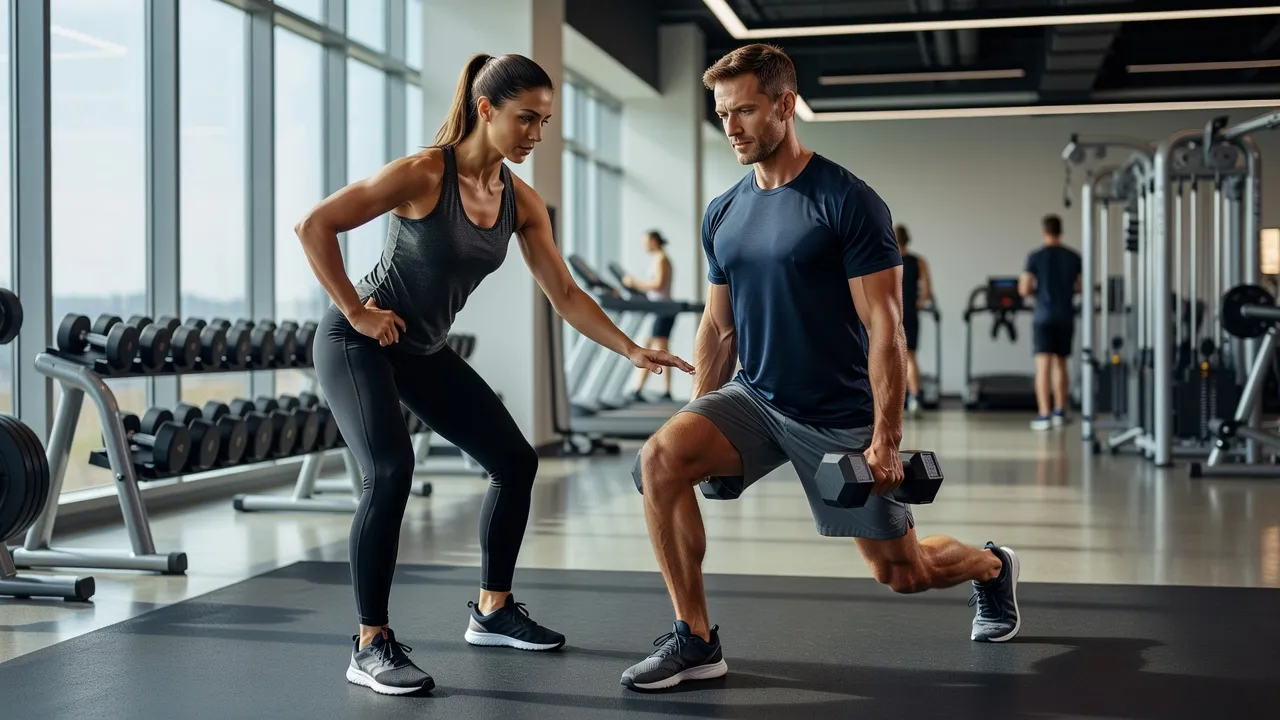
To maximize calorie burn while preserving muscle mass, ACE suggests incorporating high-intensity interval training (HIIT) two times per week. This approach preserves lower-body muscle tissue while driving the caloric deficit necessary to reveal quad and hamstring lines.
What does NASM recommend for a toned legs workout?
The National Academy of Sports Medicine (NASM) recommends structuring leg training through its Optimum Performance Training (OPT) model, starting with stabilization endurance before moving to hypertrophy. Guidelines detailed on the NASM site highlight that moving directly into heavy weights without proper joint stability leads to compensation patterns and early plateaus.
- Phase 1: Stabilization Endurance: 1-3 sets, 12-20 reps (Tempo focus)
- Phase 2: Strength Endurance: Supersets (Stable exercise + Unstable exercise)
- Phase 3: Hypertrophy: 3-4 sets, 8-12 reps (Hypertrophy focus)
Phase 1 of the NASM protocol focuses on slow tempo movements (such as a 4-2-1 squat count) to strengthen ligaments, tendons, and ankle-knee stabilization. This phase trains your body to activate the gluteus medius and inner thighs under control.
Phase 2 and Phase 3 transition into traditional strength building. NASM advocates supersetting a stable compound lift (like a leg press) with an unstable exercise (like a single-leg step-up) to recruit maximum motor units without overtaxing your lower back.
Barre vs Pilates: which is better for toned legs?
Barre is superior for building high-end endurance in your calves and quadriceps through small isometric holds, while Pilates is better for total-body alignment and hamstring length. Neither discipline builds large muscle mass, making both ideal for individuals seeking low-impact conditioning.
| Exercise Approach | Primary Target Muscle | Best For | Main Trade-Off / Limit |
|---|---|---|---|
| Heavy Strength Training | Quadriceps, Hamstrings, Glutes | Maximum muscle definition & metabolic rate | Requires gym equipment and higher joint strain |
| BodyBlend App Simulation | Digital Photo Reshaping | Instant goal preview & visual motivation | Simulates visual output; does not build physical strength |
| Barre Conditioning | Calves, Quadriceps, Stabilizers | Endurance and micro-muscle activation | Low hypertrophic potential; long timeframe for visible change |
| Mat & Reformer Pilates | Hamstrings, Glutes, Core | Posture alignment and long-line flexibility | High skill curve; requires certified instruction |
Barre utilizes high-repetition, small-amplitude pulses at the ballet barre that create a deep muscular burn in the quad muscles. This burn signals metabolic fatigue, which increases localized muscular endurance without adding volume.
Pilates uses reformer spring resistance or floor mat exercises to stretch and strengthen the posterior chain. I find Pilates especially useful for correcting pelvic tilts, which can make legs appear shorter or poorly aligned in stand-up photos.
What does Women's Health recommend for toning legs?
Women's Health recommends lifting moderately heavy weights with progressive overload rather than relying solely on high-rep, light-weight cardio workouts. Program designs cataloged by Women's Health routinely show that low-resistance bodyweight routines fail to provide enough stimulus to change muscle density.
Their training recommendations focus heavily on unilateral leg movements. Exercises like Romanian deadlifts, Bulgarian split squats, and hip thrusts force each leg to carry its own load, preventing your dominant side from taking over.
Women's Health also cautions against extreme caloric restriction. Skimping on dietary protein while doing endless cardio breaks down existing leg muscle, resulting in a soft look rather than defined quad and calf curves.
What does Men's Health recommend for toned leg workouts?
Men's Health recommends heavy compound lifting using heavy mechanical tension combined with high volume twice a week. Workouts published by Men's Health highlight progressive overload through barbell squats, heavy Romanian deadlifts, and sled pushes to build lower-body power.
Heavy Lower-Body Session
A Heavy Lower-Body Session consists of two components that proceed in parallel:
- Mechanical Tension: Heavy Barbell Squats (3-5 reps)
- Metabolic Fatigue: Walking Dumbbell Lunges (15-20 reps)
Their programming often pairs heavy strength sets (3 to 5 reps) with immediate hypertrophy finisher sets (12 to 15 reps). For example, following heavy back squats with weighted walking lunges targets both type II fast-twitch and type I slow-twitch muscle fibers.
Men's Health articles also push the importance of full depth on squats. Partial quarter-squats skip deep quad stretch and glute recruitment, robbing your legs of the tension needed to develop the sweep of the outer thigh.
5 Top Methods for Building and Visualizing Toned Legs
The process of changing your leg shape involves physical training alongside mental visualization. Here are five practical methods to build leg muscle and track your target look.
1. Progressive Compound Resistance Training
Building real muscle tissue requires pushing your legs close to muscular failure using progressive weight increases.
- How it works: Pick three to four core lifts (squats, leg press, Romanian deadlifts, calf raises) and increase either the weight or total repetitions every week.
- Why it made the list: It is the only scientifically validated method to increase muscle mass and alter your limb shape over time.
- Key trade-off: It takes 8 to 12 weeks of sustained effort before noticeable structural changes appear in the mirror.
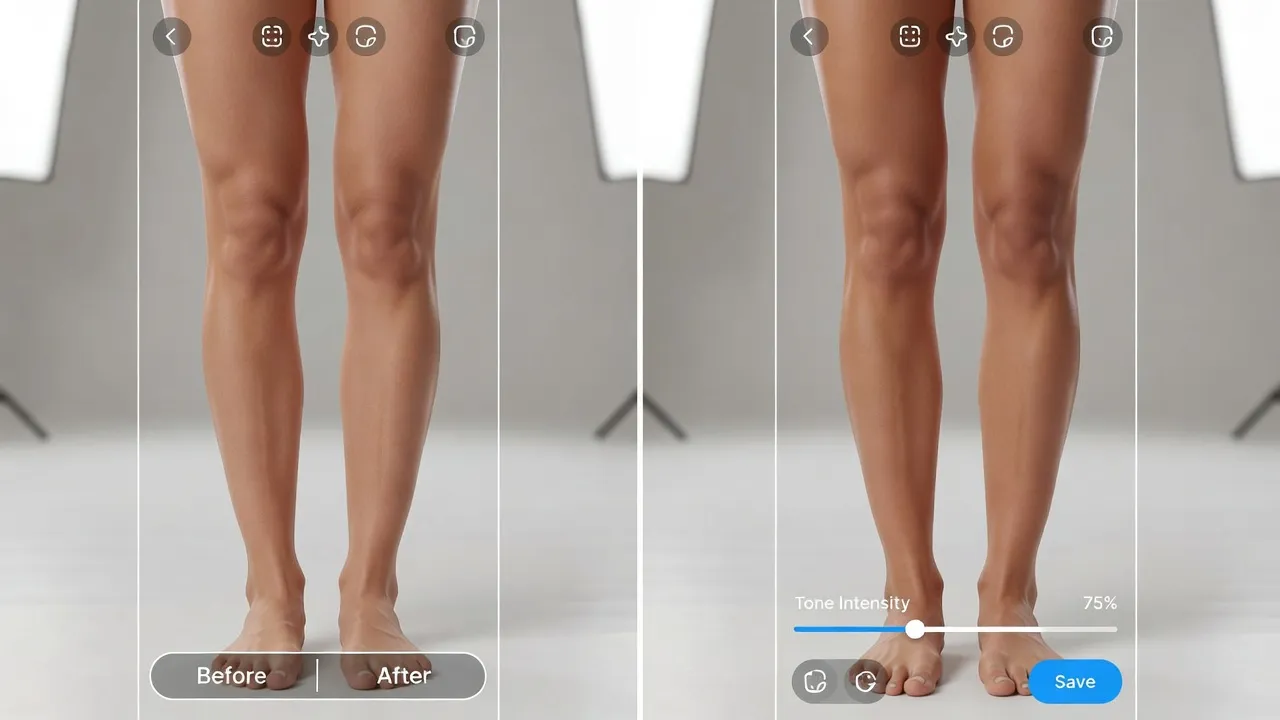
2. AI Body Shape Visualization with BodyBlend
Seeing how an athletic lower body looks on your current frame gives you a realistic target before committing to a long workout program.
- How it works: You upload your picture to the BodyBlend app, select specific body edits or presets like fit legs, and the tool adjusts your lower-body proportions using AI.
- Why it made the list: Unlike manual Liquify tools in Photoshop, BodyBlend keeps your background lines straight and preserves your original skin texture and clothing without background warping.
- Key trade-off: It provides instant visual motivation and goal setting, but it is a digital photo edit rather than a replacement for physical training.
3. High-Incline Treadmill Walking
Incline walking builds lower-body conditioning while protecting your joints from impact.
- How it works: Set a treadmill to a 10% to 15% incline and walk at a moderate pace (2.5 to 3.5 mph) for 30 to 45 minutes.
- Why it made the list: Walking on a steep slope recruits your calves, hamstrings, and glutes much harder than flat walking, creating a constant muscular burn.
- Key trade-off: It burns calories effectively, but it cannot replace heavy gym weights when it comes to building initial muscle mass.
4. High-Volume Unilateral Training
Unilateral lifts train one leg at a time, fixing side-to-side muscle imbalances and improving pelvic stability.
- How it works: Perform single-leg Romanian deadlifts, step-ups, and Bulgarian split squats using dumbbells or kettlebells.
- Why it made the list: Unilateral loading activates stabilization muscles around the knee and hip that traditional bilateral squats miss.
- Key trade-off: Single-leg work requires high balance and coordination, making it difficult for total beginners to lift heavy weights right away.
5. Nutrition-Driven Body Recomposition
Striking the right balance between protein intake and a slight caloric deficit reveals the muscle you build in the gym.
- How it works: Consume roughly 0.7 to 1.0 grams of protein per pound of target body weight daily while eating at a modest 300-calorie deficit.
- Why it made the list: Muscles stay hidden under subcutaneous fat if your overall body fat percentage remains too high.
- Key trade-off: Dropping fat too quickly causes muscle loss, leaving legs looking thin rather than athletic and shaped.
How to use BodyBlend to visualize your target leg shape
If you are planning a lower-body transformation, visualizing your target look on your own photos helps set clear goals. Using an app designed specifically for body edits avoids the common mistakes of manual photo tools.
- Download and open the app: Grab BodyBlend from the App Store listing. The app is free to download and includes one free generation so you can test it on your photos.
- Upload a clear photo: Pick a full-body photo with clean lighting where your legs are visible in standard athletic wear or swimwear.
- Select your leg edits: Choose single body part edits to adjust leg lean-ness or pick preset shapes tailored for men or women.
- Compare before and after: Tap the comparison toggle to review your original photo against the reshaped output. You can save the result directly to your camera roll for long-term goal tracking.
Using digital previews alongside realistic expectation setting keeps your fitness journey grounded. When you track progress, comparing your current state against past before and after photos ensures you stay motivated over several months of training.
How long does it take to see visible leg definition?
Most people notice initial muscle firmness within 4 weeks of consistent resistance training, but visible separation and definition take 8 to 16 weeks. The exact timeline depends on your starting body fat percentage, lifting experience, and nutrition consistency.
- Week 1 - 4: Neuromuscular adaptation & initial firmness (No visible shape change)
- Week 5 - 8: Early muscle hypertrophy & minor body fat reduction
- Week 9 - 12+: Visible quad sweep, hamstring separation, and defined calves
If you start with a higher body fat percentage, it takes longer for hidden muscle lines to show. Muscle tissue grows beneath the fat layer first. Until your overall body fat drops sufficiently, your legs might actually feel slightly larger before they look more defined.
For people who already have low body fat, adding muscle volume to the quads and hamstrings creates visible curves faster. Consistency in progressive loading matters more than constant workout variation.
What foods help build lean muscle in your legs?
To build lean muscle in your legs, eat nutrient-dense whole foods rich in high-quality protein, complex carbohydrates, and essential fatty acids. No single food targets leg fat directly, but specific nutrient ratios support recovery after heavy lower-body leg sessions.
- Lean proteins: Chicken breast, turkey, eggs, wild salmon, tofu, and whey protein isolate supply the amino acids needed for muscle repair.
- Complex carbohydrates: Sweet potatoes, brown rice, oats, and quinoa replenish muscle glycogen depleted during heavy squat and lunge workouts.
- Healthy fats: Avocados, almonds, chia seeds, and extra virgin olive oil support hormone production, including testosterone and growth hormone.
- Hydration & electrolytes: Water, sodium, and potassium prevent muscle cramping and maintain full muscle belly volume during workouts.
Skipping carbohydrates while lifting heavy lowers your workout intensity. Your muscles rely on stored glycogen to push through high-rep leg sets, so maintain moderate carb intake around your training windows.
What common mistakes ruin leg toning progress?
The most common mistakes that ruin leg toning progress are avoiding heavy weights, overdoing low-intensity cardio, and changing workouts too frequently. Expecting rapid physical changes without progressive overload leads to frustration and abandoned routines.
- Relying only on light weights: Using 2-pound dumbbells for 50 reps builds local endurance, but it does not create enough tension to shape quad or hamstring muscle.
- Skipping progressive overload: Lifting the exact same weight for the exact same reps every week gives your body zero reason to adapt or build new muscle tissue.
- Excessive cardio sessions: Running long distances every day causes high muscular fatigue, making it harder for your body to recover and build muscle mass.
- Ignoring sleep and recovery: Leg muscles rebuild during deep sleep. Sleeping fewer than 7 hours per night elevates cortisol, which encourages body fat retention.
Fixing these training errors ensures that the hard work you put in at the gym actually shows up in the mirror over time.
Frequently Asked Questions
Can I tone my legs without making them bigger?
Yes, you can tone your legs without gaining size by lifting moderate weights with moderate volume while eating at maintenance calories. Significant muscle hypertrophy requires a sustained calorie surplus and heavy progressive resistance over many months.
How many days a week should I train my legs?
You should train your legs 2 to 3 times per week with at least 48 hours of rest between sessions. This frequency allows enough volume to stimulate muscle growth while giving your tissues time to repair.
Why are my legs getting bigger instead of toned?
Your legs may temporarily look bigger because your muscles are building volume underneath an unchanged layer of body fat, or because of temporary muscle inflammation and water retention after new workouts. As body fat drops, your legs will look leaner.
Does walking downhill or on flat ground tone calves?
Flat walking maintains basic calf mobility, but walking on an incline or running stairs builds substantially more calf definition by forcing the gastrocnemius and soleus muscles to push your body weight upward.
Can an AI app show me what my legs will look like after weight loss?
Yes, dedicated body editor apps like BodyBlend let you preview a slimmer or more athletic leg shape on your own photos without distorting the background or altering your skin tone.
Are bodyweight squats enough for visible leg definition?
Bodyweight squats work well for beginners, but advanced exercisers quickly outgrow bodyweight resistance. To keep building muscle density, you must eventually add external resistance like dumbbells or kettlebells.
How do I target the inner thighs specifically?
You can emphasize the inner thighs (adductor group) by using wider foot stances during squats, sumo deadlifts, and lateral lunges. However, overall body fat reduction is still required to make inner thigh definition visible.