Body shape names - such as hourglass, pear, apple, rectangle, inverted triangle, trapezoid, and oval - classify human physical proportions based on skeletal frame, shoulder-to-hip ratio, and body fat distribution. These descriptors provide a clear geometric framework for clothing selection, fitness target planning, and personal photo tracking. If you want to visualize how different target body shapes look on your own photos before changing your fitness plan, BodyBlend is an iPhone app that lets you preview 17 target body shapes on your existing photos without distorting your clothing or background.
Visualizing Different Body Shape Types on Your Own Photos
Visualizing target body shape types on your actual photos gives you a realistic benchmark for personal styling and fitness transformations. Seeing how a change in shoulder-to-hip ratio alters your silhouette helps you set practical body composition goals.
Rather than guessing how a broader back or slimmer waist looks on your frame, visual previews turn abstract body shape names into concrete images. Standard photo tools often fail here because manual liquefy sliders warp doorframes, background walls, and clothing fabrics.
BODY SHAPE VISUALIZATION
The three stages run in order from left to right, with each stage feeding into the next. The notes for each stage sit beneath it.
- Original Photo
- Natural Pose
- Background Grid
- Real Clothing
- AI Geometry Engine
- Preserves Face
- Keeps Straight Lines
- Retains Fabric Texture
- Target Shape
- Pear / Hourglass
- V-Taper / Fit
- Zero Warping
BodyBlend solves background distortion by using generative AI instead of manual pixels dragging. You upload a full-length photo, tap one of 17 preset body shapes (such as Hourglass, Fit, Ripped, or Curvy), and let the app redraw your silhouette. The background stays completely straight, while your facial features, skin tone, and clothing textures remain untouched.
Comparing Methods for Body Shape Analysis and Goal Visualization
Selecting the right tool for identifying and visualizing body shape types depends on whether you need quick visual editing, precise tape measurements, or full 3D scans.
The comparison table below outlines the primary methods available in November 2026 for evaluating physical proportions and previews.
| Visual Tool / Method | Best Use Case | Primary Feature | Background Protection | Pricing Floor (2026) |
|---|---|---|---|---|
| BodyBlend AI Body Editor | One-tap target shape previews on real photos | 17 target presets & 11 body part edits | 100% straight background lines | Free download ($9.99/wk or $14.99/mo Pro) |
| 3D Avatar Body Scanners | Millimeter circumference tracking | Mobile mesh depth scanning | Replaces background with 3D grid | Free basic tier ($10-$20/mo) |
| Manual Tape Measurement | Traditional ratio calculations (Waist-to-Hip) | Direct physical body measurements | N/A (Physical assessment) | $5 (One-time tape purchase) |
| Manual Photoshop Liquify | Custom photo editing and manual adjustments | Manual warp and push brushes | High risk of background warping | $22.99/mo (Adobe plan) |
What are the most common body shape names for women?
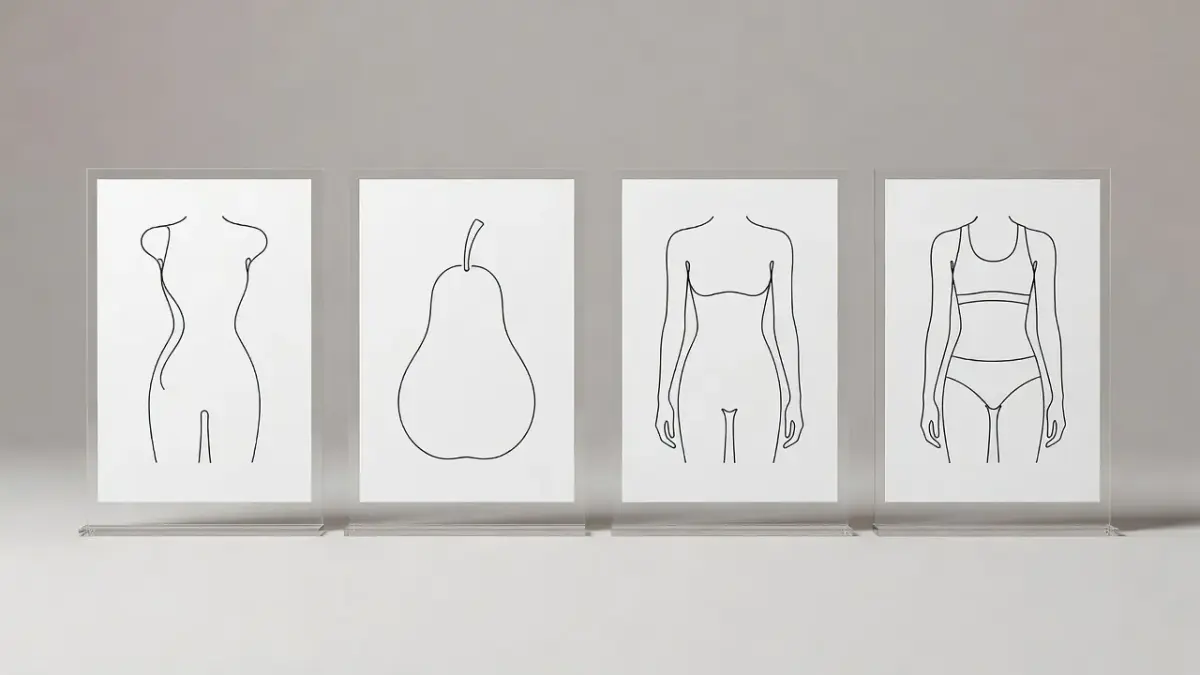
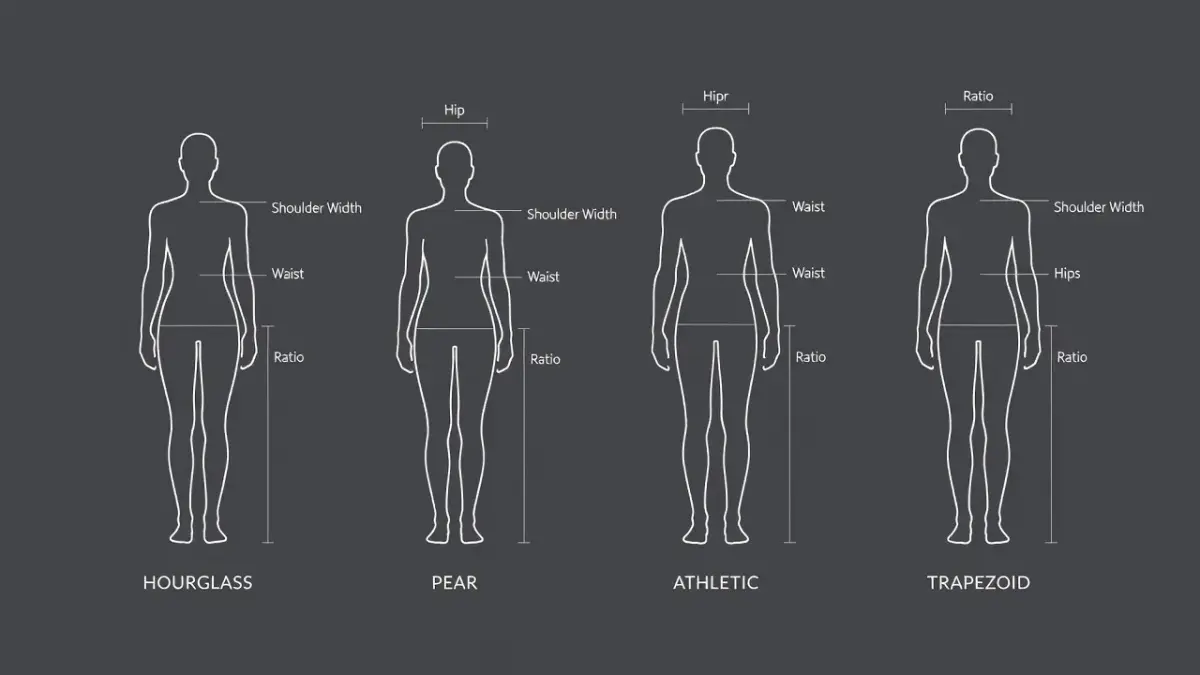
The most common female body shape names are hourglass, pear (gynoid), apple (android), rectangle (banana), and inverted triangle. These five categories form the foundation of most apparel styling guides and visual body shape reference charts.
Five body shapes are drawn side by side. Each shape is a box with three lines of text stacked from top to bottom.
| Shape | Top line | Middle line | Bottom line |
|---|---|---|---|
| Hourglass | Broad | (Waist) | Broad |
| Pear (Gynoid) | Narrow | (Waist) | Broad |
| Apple (Android) | Average | Chest | Broad Mid |
| Rectangle | Straight | Shoulder | Straight |
| Inverted Triangle | Broad | Shoulders | Narrow |
Hourglass
The hourglass shape features balanced bust and hip circumferences paired with a distinctly narrower waistline.
In traditional styling, this frame shows a waist measurement that is at least 25% smaller than the bust and hip measurements. Weight gain tends to distribute evenly across the upper and lower body while preserving waist definition.
Pear (Gynoid)
The pear shape, biologically classified as a gynoid body shape, features hips and thighs that are significantly wider than the shoulders and bust.
People with a pear structure carry body fat predominantly around the hips, glutes, and upper thighs. As noted in Wikipedia's breakdown of female body shape, gynoid fat distribution is driven by hormonal factors that concentrate adipose storage below the waist.
Apple (Android)
The apple shape carries weight primarily around the chest, waist, and upper abdomen, while maintaining slender legs and narrow hips.
Also referred to as an android distribution, this frame usually lacks a sharp waist drop-off. The torso appears full, and weight changes show up quickly around the midsection.
Rectangle
The rectangle body shape presents shoulders, waist, and hips of relatively uniform width with minimal waist curve.
Often called a straight or ruler frame, this body type shows balanced structural alignment. Muscle building and fitness routines often focus on building shoulders and glutes to create the illusion of a narrower waist.
Inverted Triangle
The inverted triangle shape features broad shoulders and a prominent chest that taper down to narrow hips and a straight waist.
This frame is common among swimmers and upper-body dominant athletes. Pants and skirts often fit loose around the hips while tops require extra room through the shoulders.
What body shape names do stylists use, such as banana, athletic and diamond?
Stylists use secondary body shape descriptors like banana, athletic, diamond, spoon, and oval to offer more specific fitting recommendations than broad traditional categories.
These terms capture subtle variations in bone frame width and localized fat storage.
- Banana: A common industry term for a tall, slender rectangle body shape with low curve definition.
- Athletic: Characterized by wide shoulders, visible muscle tone, tight glutes, and low body fat levels.
- Diamond: Features a midsection that is wider than both the shoulders and hips, often accompanied by slender calves and forearms.
- Spoon: Similar to a pear, but features a distinct shelf-like hip bone curve and a higher waistline indentation.
- Oval: Concentrates volume in the central torso area, creating a rounded outline with small hips and shoulders.
Understanding these nuanced terms helps when selecting clothes off the rack. A diamond shape requires totally different jacket tailoring than a banana shape, even if both share similar height and weight metrics.
What are the primary men's body shape types?
The primary men's body shape types include trapezoid, rectangle, inverted triangle, oval, and triangle.
Male body types shape classification centers largely on the shoulder-to-waist ratio, which dictates how suits, shirts, and casual wear drape across the upper body.
The five body shape types are drawn side by side in a single row, from left to right:
- Trapezoid: wider top edge, narrower bottom edge.
- Rectangle: straight sides with the same width at top and bottom.
- Inverted triangle: wide top edge narrowing toward the bottom.
- Triangle: narrow top edge widening toward a wide bottom edge.
- Oval: a rounded outline with no straight edges.
Trapezoid
The trapezoid frame features broad shoulders and chest tapering gently down to a moderately narrow waist.
Fashion designers treat the trapezoid as the standard off-the-rack baseline for men's tailored suits. The chest and shoulders comfortably fill jackets without straining, while trousers drape clean without excess fabric at the waist.
Rectangle
The male rectangle shape presents a straight vertical silhouette where shoulders, waist, and hips share equal proportions.
Men with this frame often aim to add shoulder and back width through weightlifting to approximate a taper. Styling tips usually focus on layered clothing to add visual bulk across the upper body.
Inverted Triangle
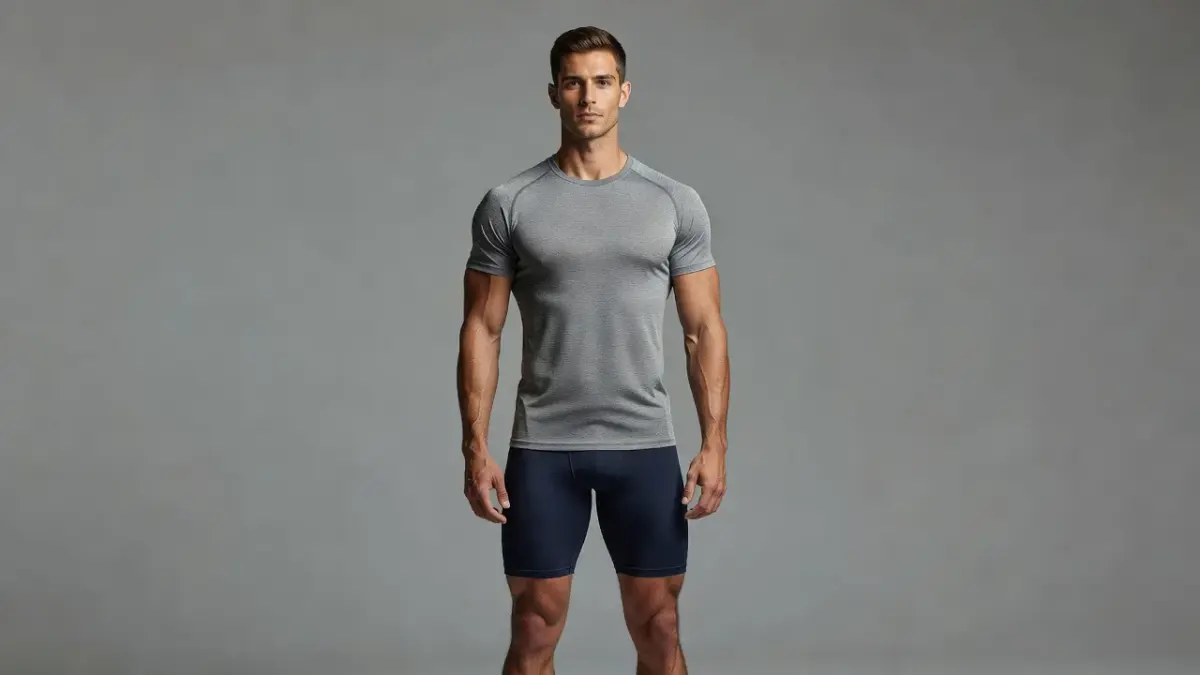
The male inverted triangle, often termed an athletic V-taper, features very broad shoulders tapering sharply down to a small waist.
This shape is typical among bodybuilders and strength athletes. Finding off-the-rack shirts can be tough because garments fitting the chest leave far too much loose material at the waist. You can read more about achieving a V shape torso definition and ratios to understand the underlying skeletal and muscle balance.
Triangle
The triangle body shape features a lower body and abdomen that are wider than the shoulders and chest.
Weight in a triangle frame accumulates around the lower waist and hips. Personal styling for this type aims to widen the upper shoulder line using structured jacket padding or horizontal chest patterns.
Oval
An oval shape concentrates physical mass around the center of the torso, leading to a rounded belly and softened shoulder lines.
In fitness context, men with an oval distribution often fit the meso-endomorph body type classification. They combine dense underlying muscle with a genetic tendency to store visceral and subcutaneous waist fat.
Do stylists recommend using body shape names like hourglass, pear and apple?
Yes, many professional image consultants still recommend using core body shape names because they simplify clothes selection into clear proportion rules.
These labels help people quickly identify which clothing cuts balance their frame.
- Proportion balancing: Knowing you have broad shoulders (inverted triangle) tells you to add volume to your lower half with wide-leg pants.
- Visual focus: Fruit and shape labels give people an intuitive target for photo posing and camera angles.
- Quick filtering: Online shopping filters and styling blogs frequently use these exact body shape names to group outfit ideas.
While these terms are helpful, stylists treat them as starting guidelines rather than rigid rules. Understanding your individual proportions of the body matters far more than sticking strictly to a single category label.
Why do some fashion stylists advise avoiding body shape labels?
Some fashion stylists advise avoiding body shape labels because fruit metaphors can feel reductionist and fail to account for unique body variations.
Strict category boxes often ignore key structural factors like torso height, hip bone angle, and leg length.
Traditional categories are listed on the left, and an arrow points from them to the modern styling approach listed on the right.
| Traditional Categories | Modern Styling Approach |
|---|---|
| Hourglass | Shoulder Alignment |
| Pear | Torso Length |
| Apple | Hip Bone Angle |
| Rectangle | Inseam Balance |
Research published by the National Institutes of Health emphasizes that human adipose tissue distribution and skeletal geometry vary along a continuous spectrum rather than discrete steps. Comparing someone's body to an apple or banana can trigger negative self-perception or cause frustration when off-the-rack clothes fail to fit.
Modern stylists increasingly prefer working with vertical lines, fabric drape, and personal fit comfort over force-fitting clients into rigid geometric categories.
Should stylists say body shape, body type or silhouette?
Stylists should choose between body shape, body type, or silhouette based on whether they are talking about outfit lines, biological composition, or garment outlines.
While people often mix up these terms, they describe different aspects of your appearance.
Body Shape
Body shape describes the structural geometry of your frame based on your skeletal structure and localized fat distribution.
Terms like pear, rectangle, and trapezoid belong here. It is a static geometric classification.
Body Type
Body type refers to underlying biological somatotypes that reflect metabolic traits and muscle-to-fat ratios.
Categories like ectomorph, mesomorph, and endomorph belong in this group. Fitness trainers rely on body type descriptors to design workout routines and diet strategies.
Silhouette
Silhouette describes the overall dark outline created when clothes drape over your body frame.
Unlike fixed body shapes, you can change your silhouette instantly using structured jackets, high-waisted pants, or shapewear.
How do I find out what body shape I am?
You can find out your body shape by measuring four key points with a flexible tape measure: shoulders, bust/chest, waist, and hips.
Comparing these numbers reveals your exact structural ratios.
-
SHOULDERS (Widest point across arms)
- Symbol beneath the label: \ / (drawn as two strokes splayed outward from a narrower top)
-
BUST / CHEST (Fullest part)
- Symbol beneath the label: ( ) (drawn as a rounded pair of brackets)
-
WAIST (Narrowest point above navel)
- Symbol beneath the label: > < (drawn as two angle brackets facing each other)
-
HIPS (Widest point over glutes)
- Symbol beneath the label: / \ (drawn as two strokes splayed outward from a narrower top, the mirror of the shoulder symbol)
-
Measure Shoulders: Wrap the tape around the highest point of your shoulders, just below the neck.
-
Measure Bust/Chest: Stand straight and measure around the fullest part of your chest without pulling the tape tight.
-
Measure Waist: Find your natural waistline, which is the narrowest point of your torso, usually an inch above your navel.
-
Measure Hips: Stand with your feet together and measure around the fullest part of your hips and glutes. To understand how bone structure affects this area, see our guide on the 5 primary hip shapes.
-
Calculate Your Ratios:
- If your waist is 25% smaller than your shoulders/bust and hips, you match the Hourglass profile.
- If your hips measure at least 5% larger than your shoulders, you match the Pear profile.
- If your shoulders measure 5% larger than your hips, you match the Inverted Triangle profile.
- If all measurements sit within 5% of each other, you match the Rectangle profile.
Using AI Visualizers to Test Target Body Shapes
Using an AI body editor lets you see realistic preview goals on your own photos before committing to a fitness program or buying new clothes.
Testing virtual body adjustments helps set clear expectations for muscle building or weight loss.
BODYBLEND PHOTO TRANSFORMATION
The three steps run in order, left to right, joined by arrows. Each step has two items listed beneath it.
- Upload Photo
- Front Pose
- Normal Light
- Choose Preset Target
- Ripped / Muscular
- Hourglass / Slim
- Download Preview
- Clean Background
- Original Face
When using BodyBlend, you can apply general body shape presets or focus on 11 specific body part edits. For example, you can widen your shoulders, add visible arm muscle, or trim your midsection individually.
Because the app handles men's and women's bodies separately, edits preserve natural muscle curves and bone proportions without distorting background walls or lighting.
Frequently Asked Questions
What is a gynoid body shape?
A gynoid body shape, commonly known as a pear shape, is a body structure where fat accumulates primarily around the hips, thighs, and buttocks. This pattern is influenced by estrogen levels and is most frequently seen in women. Gynoid fat storage is subcutaneous, sitting right below the skin rather than deep around abdominal organs.
What does a meso-endomorph body type look like?
A meso-endomorph body type combines natural muscle density with a genetic tendency to store body fat easily. People with this hybrid frame look stocky and strong, featuring broad shoulders, thick wrists, and a wide waist. As documented in Encyclopaedia Britannica's entry on human somatotypes, mesomorphic strength combined with endomorphic fat storage creates a solid physique that gains both muscle and fat quickly.
How does body fat distribution change my body shape?
Body fat distribution changes your body shape by adding volume to specific storage zones defined by genetics, age, and hormone levels. Hormonal shifts, such as drops in estrogen during menopause, can transition a frame from a gynoid (pear) pattern to an android (apple) distribution. Weight loss shrinks these fat deposits overall, revealing your underlying skeletal frame.
What is the rarest body shape name for women?
The hourglass shape is statistically the rarest female body shape, representing under 10% of women. Most adult women naturally fit rectangle or pear shape profiles due to common skeletal proportions and normal body fat storage patterns.
How do body shape descriptions differ between men and women?
Female body shape descriptions focus on waist-to-hip ratio and curve balance, while male shape descriptions center on the shoulder-to-waist taper. Women's terms use categories like hourglass, pear, and apple, whereas men's terms prioritize geometric shapes like trapezoid, rectangle, and inverted triangle.
Can workout routines permanently change your natural body shape?
Workout routines alter your muscle volume and fat percentage, but they cannot change your underlying bone structure or joint width. You can widen your shoulder line with lateral delt training or build glute projection with heavy hip thrusts, altering your overall silhouette even though your skeletal frame remains the same.
What is the difference between body shape and somatotype?
Body shape describes outward geometric measurements, while somatotype classifies metabolic traits and muscular makeup into ectomorph, mesomorph, and endomorph categories. Body shape focuses on how clothes fit your frame, whereas somatotype outlines how your body responds to exercise training and diet regimes.