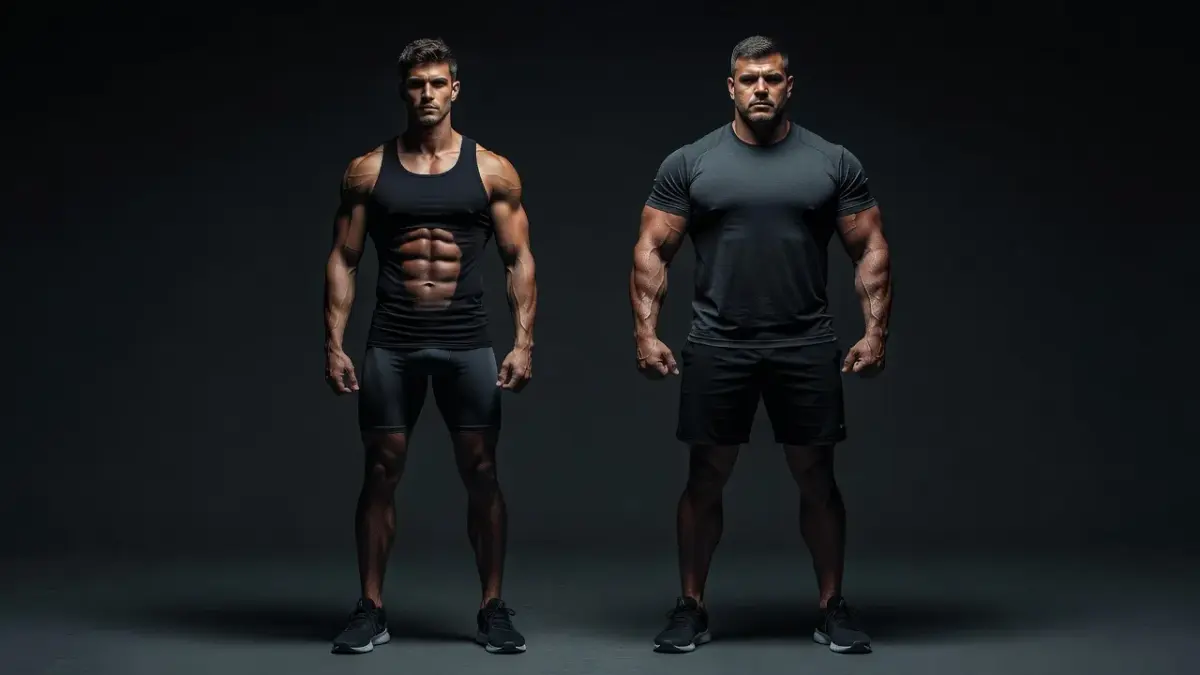
Physiologically, lean muscle and bulk muscle are the exact same muscle tissue, but the terms describe drastically different aesthetics based on your total body fat percentage. A "lean muscle" look combines dense muscle tissue with low body fat (typically 8% to 12% for men and 16% to 20% for women), whereas a "bulk muscle" look pairs that same muscle tissue with higher body fat (15% to 22%+ for men and 24% to 30%+ for women), creating a larger, denser frame. If you want to see how these different physiques actually look on your own frame before committing to months of dieting, our iPhone app BodyBlend lets you instantly preview target body shapes directly on your photos.
Lean Muscle Look and Bulk Muscle Look sit side by side, each listing four items in the same order. Below both lists, lines from each side converge on the label "Same Skeletal Muscle Tissue."
| Lean Muscle Look | Bulk Muscle Look |
|---|---|
| High Definition | Maximum Mass & Size |
| Low Body Fat | Moderate Body Fat |
| Visible Striations | Thicker Waistline |
| Chiseled Appearance | Fuller, Broader Frame |
Lean Muscle vs Bulk Muscle: What Is the Difference?
The primary difference between lean muscle and bulk muscle is the amount of subcutaneous fat covering the muscle tissue, not the muscle tissue itself. Skeletal muscle contracts and grows through the same biological process known as hypertrophy, regardless of your physique goals.
When people speak about building "lean muscle," they usually mean adding muscle mass while minimizing body fat gain to preserve vascularity and abdominal definition. Conversely, "bulk muscle" describes a physique prioritized around maximum muscle volume and absolute strength, where carrying extra body fat is accepted as part of the trade-off.
Understanding this distinction prevents one of the most common fitness errors: eating in an uncontrolled calorie surplus under the mistaken belief that extra calories automatically transform into thicker muscle fibers. Fat tissue and muscle tissue are completely separate biological systems, and force-feeding only expands your fat cells.

Should I bulk or cut?
You should cut first if your body fat is above 15% for men or 23% for women, and you should bulk if your body fat is below 10% for men or 18% for women. Choosing the wrong starting point is where most lifters waste six to twelve months of hard work in the gym.
Entering a mass-gaining phase when you already carry excess fat leads to poor insulin sensitivity and higher rates of fat storage compared to muscle gain. On the flip side, trying to cut when you have little underlying muscle mass leaves you looking depleted rather than athletic.
If you fall into the middle range (10% to 15% fat for men, 18% to 23% for women), your choice comes down to personal visual preference. I usually recommend spending 12 to 16 weeks in a subtle calorie surplus to build a solid muscular foundation before attempting a dedicated leaning phase.
Is body recomposition better than bulking?
Body recomposition is better than traditional bulking for untrained beginners, returning lifters, and individuals carrying high body fat, but traditional bulking is superior for experienced, lean lifters. Recomposition allows you to build muscle and lose fat simultaneously by eating near maintenance calories while prioritizing heavy resistance training.
According to a review published on PubMed, non-elite athletes can synthesize new muscle mass while tapping into stored body fat for energy. This makes recomposition an ideal entry strategy because you avoid the fat gain associated with aggressive eating plans.
However, advanced lifters with years of continuous training experience hit a point of diminishing returns. For experienced athletes, dedicated lean bulking cycles are far more efficient for forcing hyper-trophic growth than staying at maintenance calories.
What is the difference between a lean bulk and a dirty bulk?
A lean bulk uses a controlled daily calorie surplus of 200 to 300 calories with whole foods, while a dirty bulk uses an unconstrained surplus of 500 to 1,000+ calories with high-calorie processed foods. The end goal of both methods is muscle growth, but their long-term impact on your body composition is completely different.
| Feature / Strategy | Traditional Dirty Bulk | Controlled Lean Bulk | BodyBlend AI Visual Goal |
|---|---|---|---|
| Best Suited For | Hardgainers struggling with appetite | Lifters wanting year-round definition | Anyone setting realistic photo targets |
| Daily Calorie Surplus | +500 to +1,000 kcal | +200 to +300 kcal | N/A (Visual outcome tool) |
| Monthly Fat Gain Ratio | 50% to 70% fat | 20% to 30% fat | 0% fat (Simulated image) |
| Dietary Focus | Unrestricted, dense foods | Whole foods, high protein | Instant iPhone photo preview |
| Cardiovascular Impact | Often increases blood pressure | Maintains metabolic health | N/A |
| Post-Phase Cut Needed | Long and grueling (12-16 weeks) | Short and light (4-6 weeks) | None required |
The biggest flaw with a dirty bulk is that your body can only synthesize a limited amount of muscle tissue per day. Any excess energy beyond that physiological ceiling is deposited directly into adipose tissue, resulting in months of painful dieting later to strip off the accumulated fat.
If you are trying to decide which aesthetic matches your personal style, check out our guide on the shred body type to see how lower fat levels alter muscle definition.

How big a calorie surplus is recommended for a lean bulk?
A daily surplus of 250 calories above your total daily energy expenditure (TDEE) is the optimal recommendation for a lean bulk. This small surplus provides all the energy necessary to drive muscle protein synthesis without overwhelming your metabolic system with excess calories.
For most lifters, 250 calories equals roughly one extra protein shake or two eggs with a slice of whole-grain toast each day. As of November 2026, exercise science consensus strongly favors these smaller surpluses over historical "bulking" norms that urged lifters to eat everything in sight.
If you notice your waist measurement expanding faster than your chest and arms, your surplus is likely too high. Scale your daily intake back by 100 to 150 calories until your body weight increases at a controlled rate.
How fast should you gain weight per week to build muscle?
Beginners should target a weight gain of 0.25% to 0.5% of their total body weight per week, while advanced lifters should aim for 0.1% to 0.25% per week. For a 180-pound individual, this translates to roughly 0.5 to 0.9 pounds per week for beginners and under 0.4 pounds per week for experienced lifters.
Gaining weight faster than these targets almost guarantees that the excess mass is fat rather than functional muscle mass. As defined by Wikipedia's entry on Muscle Hypertrophy, actual muscle tissue growth is a slow process governed by protein synthesis rates, satellite cell activation, and biological recovery limits.
OPTIMAL WEEKLY WEIGHT GAIN RATES (LEAN BULK)
Each level has a bar drawn beside its rate. The bars are in descending order of length: the BEGINNER bar is the longest, the INTERMED. bar is shorter, and the ADVANCED bar is the shortest.
| Level | Body Weight / Week |
|---|---|
| BEGINNER | 0.25% - 0.50% |
| INTERMED. | 0.25% |
| ADVANCED | 0.10% - 0.20% |
Tracking your weight daily and taking a weekly average keeps your progress honest. If your weekly average jumps by two pounds in seven days, you have accumulated water and fat, not two pounds of new skeletal muscle.
How much protein per kg is recommended for muscle growth?
The optimal protein intake for maximizing muscle growth is 1.6 to 2.2 grams of protein per kilogram of body weight per day (0.73 to 1.0 grams per pound). Eating more than this range does not trigger additional muscle growth, though it can help control hunger during a cutting phase.
The International Society of Sports Nutrition (ISSN) stands by this 1.6–2.2 g/kg recommendation as the benchmark for active individuals engaged in resistance training. Distributing this protein across three to five meals throughout the day ensures that muscle protein synthesis remains constantly elevated.
For example, an 80 kg (176 lb) lifter should aim for roughly 130 to 175 grams of daily protein. Sourcing this intake from lean poultry, fish, eggs, tofu, and quality dairy keeps your meals nutrient-dense while hitting your targets.
Visualizing Transformation Outcomes with BodyBlend
One of the hardest parts of deciding between a lean bulk and a full bulking cycle is knowing how that added mass will look on your specific body structure. We built BodyBlend to solve this exact visual guessing game for iPhone users.
Instead of relying on generic body charts or guessing what an extra 10 pounds of muscle will look like on your shoulders and chest, BodyBlend lets you edit your existing photos in one tap. You simply upload a full-body picture, select from 17 target preset shapes - like Muscular, Fit, or Ripped - or apply single-part adjustments like muscular arms or visible abs.
BODYBLEND AI SHAPE ENGINE
The three steps sit in one row, read left to right, with arrows pointing from each step to the next:
- Upload Photo
- Choose Preset
- 1-Tap Output
The drawing also lists these notes beneath the flow:
- Keeps face & skin tone original
- Leaves background straight (no Liquify warping)
- Renders realistic target muscle mass
Unlike traditional photo apps that warp background walls or stretch your skin unnaturally, BodyBlend’s AI redrawing engine keeps your original face, skin tone, clothing, and background perfectly intact. It acts as a digital target tool, allowing you to see your potential physique transformation before you alter your diet or workout plan.
If you are currently setting up a long-term workout routine, check out our fitness transformation guide for realistic timelines on matching your physical progress to your visual target goals.

Common Mistakes When Building Muscle (and How Much They Cost You)
The most costly mistake in muscle building is running an aggressive dirty bulk that forces you into a long, muscle-wasting diet phase later. When you gain fat too rapidly, you inevitably have to cut for 16 to 20 weeks instead of a quick 6-week tune-up.
Here are the four biggest mistakes lifters make when trying to choose between lean and bulky muscle goals:
- Mistake 1: Expecting overnight muscle growth. Building genuine muscle tissue takes time. Natural lifters rarely build more than 10 to 15 pounds of true lean muscle in their entire first year of training, with that rate cutting in half every subsequent year.
- Mistake 2: Changing programs every three weeks. Constantly switching your workout split prevents progressive overload. Pick a proven routine, stick with it for at least 12 weeks, and log your weights.
- Mistake 3: Ignoring body part proportions. Chasing raw size often leads to overdeveloped chest and mirror muscles while neglecting shoulders, upper back, and legs. You can explore our breakdown on AI muscle generators to learn how proportional adjustments drastically alter your visual symmetry.
- Mistake 4: Overestimating daily calorie expenditure. Online calculators often overestimate your baseline burn. If you base a 500-calorie surplus on an inflated baseline, your actual surplus might be 800+ calories, accelerating fat storage.
The Dirty Bulk Returning-Cost Timeline
Each phase in the middle column leads to the result in the right-hand column of the same row.
| Months | Phase | Result |
|---|---|---|
| 1-4 | Fast eating (+800 kcal) | Gains: 4 lbs Muscle / 12 lbs Fat |
| 5-8 | Hard Cutting (-600 kcal) | Loss: 10 lbs Fat / 2 lbs Muscle |
NET RESULT: 8 Months spent for only 2 lbs of net muscle gain.
I recommend taking chest, waist, and arm measurements every two weeks alongside scale weight. If your waist is growing twice as fast as your chest, scale back your calories immediately to realign with a lean bulk trajectory.
Recommended Strategy Based on Your Physique Type
If you are naturally lean with narrow shoulders (ectomorph), lean toward a slightly higher calorie surplus (+300 to +400 kcal); if you carry extra weight around your midsection (endomorph), prioritize body recomposition or a tiny surplus (+150 kcal). Matching your diet approach to your starting frame saves you weeks of frustration.
- For the Skinny-Fat Lifter: Avoid aggressive bulking. Eat at maintenance calories, hit 2.0 g/kg of protein, and focus on lifting heavier weights three to four days per week.
- For the Lean Hardgainer: You have permission to eat more carbohydrates. Add dense calorie sources like nut butters, oats, and whole milk to hit your daily targets easily.
- For the Already-Muscular Lifter: Focus entirely on proportional weaknesses rather than overall scale weight. Adding half an inch to your lateral deltoids will improve your shape far more than adding five pounds of scale weight.
Visualizing these changes before committing to a diet helps keep your expectations aligned with reality. Try testing different muscle targets on your iPhone using BodyBlend so you know exactly which physical attributes you want to prioritize in the gym.
Frequently Asked Questions
Can I turn fat directly into lean muscle?
No, fat tissue and muscle tissue are two completely separate biological structures and cannot convert into one another. Fat cells store triglycerides for energy, while muscle fibers consist of protein filaments that contract. When you work out in a calorie deficit, your body burns stored fat for fuel while using dietary protein to repair and build muscle tissue.
Why do I look bigger but less muscular when I bulk?
You look less defined during a bulk because accumulated body fat smooths over the edges, striations, and separation between your muscles. Muscle size increases under the skin, but if the layer of subcutaneous fat above it thickens at the same time, your body loses its sharp contour and looks soft rather than athletic.
How long does a lean bulk take to show visible results?
Visible changes from a lean bulk typically take 8 to 12 weeks of continuous training and accurate nutrition. Because fat accumulation is kept low, muscle additions occur gradually at roughly 0.5 to 1.5 pounds per month, which becomes noticeable in photos over a 90-day period.
Will heavy lifting make me look bulky instead of lean?
No, lifting heavy weight builds dense muscle tissue, which creates a firm and defined look rather than a bulky one. The "bulky" appearance only happens when heavy training is paired with a large calorie surplus that adds significant body fat over top of the new muscle.
How do I know if I am building muscle or just getting fat?
You are building muscle if your strength numbers in the gym are steadily rising while your waist measurement stays relatively stable. If scale weight increases rapidly but your lifts stall and your waistline expands, most of the weight gain is coming from body fat.
Is lean muscle heavier than fat?
Lean muscle is denser than body fat, meaning one pound of muscle occupies less physical volume than one pound of fat. Five pounds of muscle tissue looks compact and sculpted on your frame, whereas five pounds of fat tissue takes up significantly more physical space.
Do I need supplements to build lean muscle mass?
No, supplements are optional and only provide a minor benefit compared to consistent training, adequate protein, and quality sleep. Creatine monohydrate and whey protein powder are useful tools for convenience, but they cannot replace a structured diet plan.